
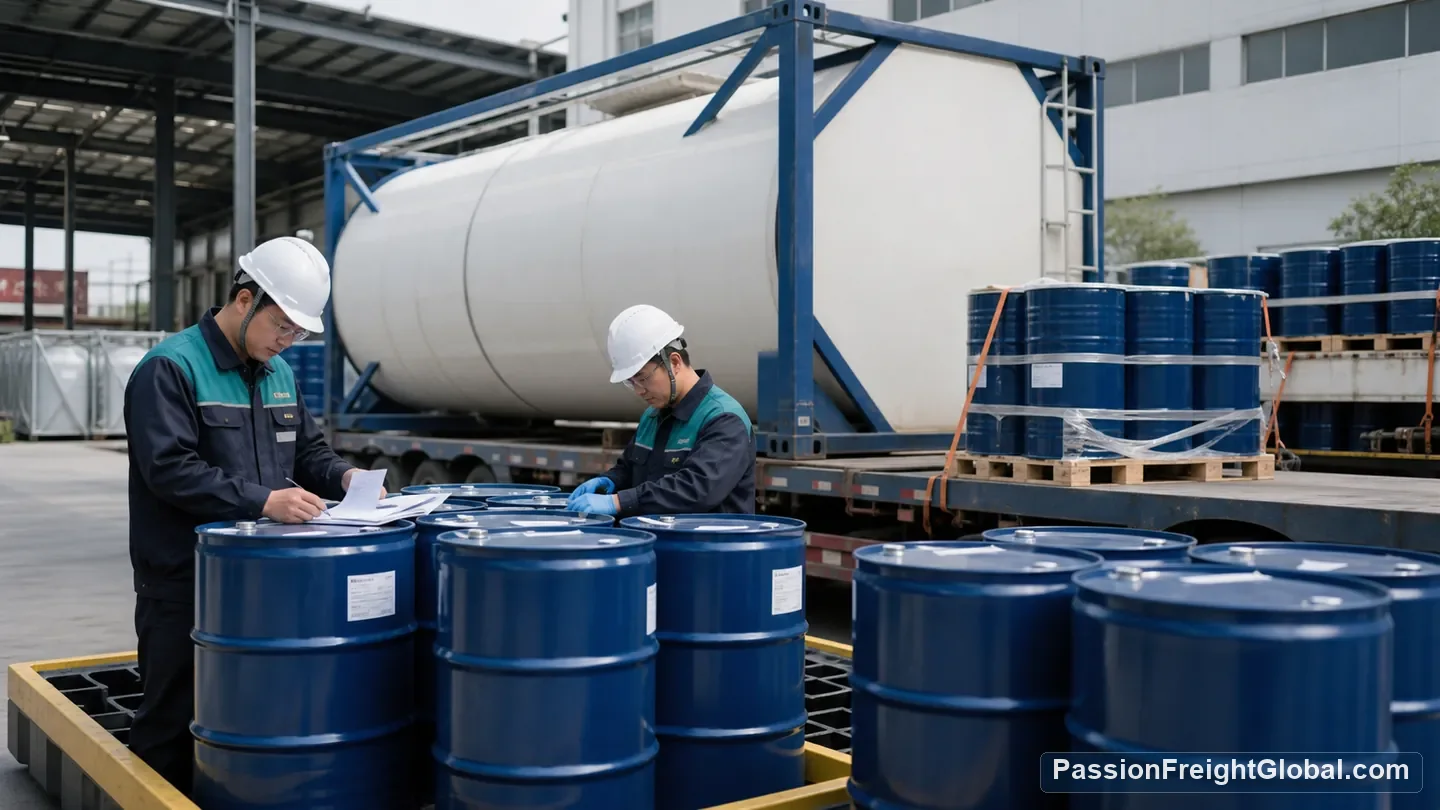
The word oil covers products with very different transport and export controls. Lubricants, base oils, additives, fuels and mixtures should not be quoted under one generic description because composition, flash point, marine-pollutant status and customs classification can change the entire route.
What to verify before asking for a firm booking
| Decision | Evidence to request | What it changes |
|---|---|---|
| What is the liquid? | Current SDS, composition or grade, CAS information where relevant, flash point, viscosity, density and transport section. | Dangerous-goods classification, packaging and carrier options. |
| Is export controlled? | HS code, product use, trade mode and screening against the current China export-licence catalogue. | Whether the exporter needs quota, licence or specialist customs review. |
| Which containment is compatible? | Product compatibility, cleaning certificate where applicable, fill ratio, closure, leak test and package approval. | Drum, IBC, flexitank or ISO-tank feasibility. |
| What happens at both ends? | Loading pump and hose, temperature, spill controls, tank return, discharge access and receiving storage. | Origin/destination scope, equipment and total cost. |
A practical China-export sequence
- Use the exact commercial grade and current SDS; do not quote from a generic family name.
- Verify classification and flash-point evidence with a dangerous-goods specialist when the SDS is incomplete or inconsistent.
- Check HS code and the current export-licence catalogue before promising customs clearance for fuels or controlled products.
- Confirm packaging or tank compatibility, prior-cargo restrictions, cleaning evidence and loading/discharge equipment.
- Plan spill containment, seals, weights, VGM, port acceptance and emergency information before the cargo enters the port chain.
The mistake that creates the most avoidable risk
Do not state that every lubricant is non-dangerous or that every oil needs the same export licence. Classification and licensing depend on the exact product, properties, HS code and current regulations.
Official references to check before booking
Rules and operator policies change. These links are starting points; confirm the latest requirement with the exporter, competent authorities and the named carrier for the actual shipment.
- IMO — International Maritime Dangerous Goods Code
- UNECE — ADR 2025 dangerous-goods road transport
- China MOFCOM — 2026 export-licence catalogue
Buyer questions
Questions buyers ask after the first industrial liquids & oils review
Short answers for the doubts that remain after a first quotation. Final acceptance still depends on the actual product, shipper, carrier, route and destination.
Is an SDS enough to prove that an industrial oil is non-dangerous?
It is a starting point, not automatic proof. Check whether the SDS is current, product-specific and consistent with flash point, composition and the applicable transport rules.
When is an ISO tank better than drums?
An ISO tank can suit larger compatible liquid volumes, but cleaning, prior cargo, fill limits, loading and discharge equipment, return logistics and port acceptance must be compared.
Do lubricants need the same China export licence as refined fuel?
Not necessarily. The 2026 catalogue distinguishes product groups. Confirm the HS code and current licensing position with the exporter and customs specialist.
Can a flexitank carry any non-dangerous oil?
No. Product compatibility, viscosity, temperature, container condition, flexitank approval, loading method and carrier policy still determine whether it is workable.